Hono vs Express in 2026
Hono vs Express comes down to where your code runs. Hono is built on Web Standards, has zero dependencies and runs on Cloudflare Workers, Deno, Bun, Vercel, Netlify, AWS Lambda and Node.js. Express is the long-standing Node.js framework with the biggest middleware ecosystem, and Express 5 now forwards errors from async handlers to your error middleware.
Facts and prices checked on against the sources listed below.
Quick verdict
Hono
PriceFree, open source
Pick Hono for edge and serverless deploys, small bundles, or one codebase that runs on several runtimes, with typed routes and an RPC client.
Express
PriceFree, open source
Pick Express for a classic Node.js server, a team that already knows it, or when you need a specific Express middleware package.
Hono vs Express at a glance
| Feature | Hono | Express |
|---|---|---|
| Built on | Web Standards (Request, Response, fetch) | Node.js http, with its own req and res objects |
| Runtimes | Cloudflare Workers, Fastly, Deno, Bun, Vercel, Netlify, AWS Lambda, Node.js | Node.js 18 or higher |
| Dependencies | Zero | Several npm packages |
| Size | hono/tiny preset under 14 kB minified | The Hono docs put Express at 572 KB |
| Middleware | Built in: CORS, JWT, auth, cache, compress, logger, secure headers and more | Large ecosystem of community packages |
| TypeScript | Written in TypeScript; typed path params and an RPC client (hc) | Types through @types/express |
| Latest release | 4.13.13 on npm; 5.0.0-rc.1 is a pre-release | 5.3.0 (9 Oct 2026); 4.22 still on npm |
| License and stars | MIT, 32.6k stars | MIT, 69.6k stars |
| Free tier | Free and open source (MIT) | Free and open source (MIT) |
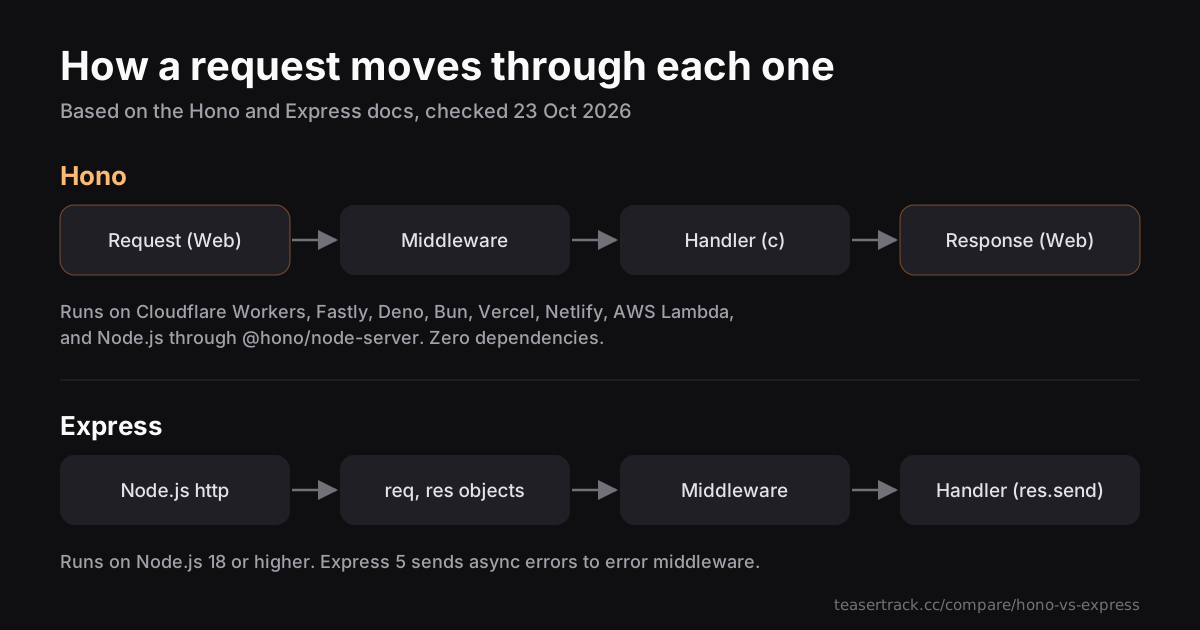
Web Standards or Node.js objects
Express handlers get Node.js req and res objects and run on a Node.js server. That is why Express runs on Node.js only, and why it has the largest set of middleware written for it.
Hono handlers get a Web Standard Request and return a Response, the same objects fetch uses. Because those objects exist on every modern runtime, the same Hono app runs on Cloudflare Workers, Fastly Compute, Deno, Bun, Vercel, Netlify, AWS Lambda and, through the @hono/node-server adapter, on Node.js.
// Hono
import { Hono } from "hono";
const app = new Hono();
app.get("/hello", (c) => c.json({ ok: true }));
export default app;
// Express
import express from "express";
const app = express();
app.get("/hello", (req, res) => res.json({ ok: true }));
app.listen(3000);
Size and speed
Hono has zero dependencies, and its hono/tiny preset is under 14 kB minified. Its docs show a Cloudflare Workers upload of 11.47 KiB and compare that with Express at 572 KB. Small bundles matter most on edge and serverless platforms, where cold starts and upload limits are real costs.
On speed, Hono publishes a benchmark against other Cloudflare Workers routers, with Hono at about 402,820 operations per second. There is no Express number in it, since Express does not run on Workers. On a Node.js server, the difference between routers is rarely what slows an app down.
Middleware and ecosystem
Hono includes much of what you would install for Express: CORS, JWT, basic and bearer auth, body limit, cache, compress, cookie, ETag, logger, secure headers, streaming and JSX. Third party middleware covers GraphQL, Firebase Auth and Sentry, among others.
Express has the bigger ecosystem by far, and most Node.js tutorials and examples still use it. Express middleware does not plug into Hono as is, so if your app depends on a specific package, check for a Hono version or a built in replacement before you move.
TypeScript and RPC
Hono is written in TypeScript. Path parameters get literal types, so a route like /entry/:date/:id knows its parameter names. With the validator (Zod is a common choice) and the hc client, Hono can share the API types with your frontend in what it calls RPC mode.
Express is written in JavaScript; you add types with @types/express.
What Express 5 changed
Express 5 is the current major version (5.3.0 on 9 October 2026). It needs Node.js 18 or higher. Async handlers that throw or return a rejected promise now pass the error to your error middleware, as if you called next(err). Path matching is stricter: a wildcard needs a name, as in /*splat, and optional parts use braces. Old methods such as app.del(), req.param() and res.send(status) are gone. If you start a new Express app, start on version 5.
When to pick Hono
- You deploy to Cloudflare Workers, Deno, Bun or another edge or serverless runtime.
- You want one codebase that can move between runtimes.
- You want typed routes and a typed client without a code generator.
When to pick Express
- You run a classic long-lived Node.js server.
- Your team knows Express, or you need a specific Express middleware.
- You follow a tutorial or a codebase that already uses it.
This page is based on the official Hono and Express documentation, their GitHub repositories and npm, not on our own benchmarks.
FAQ
Is Hono faster than Express?
The Hono benchmark on Cloudflare Workers puts it at about 402,820 operations per second, ahead of other Workers routers. Express does not run on Workers, so that page has no like for like number. On Node.js, measure with your own routes: the database usually costs more than the router.
Can Hono run on Node.js?
Yes, through the @hono/node-server adapter. The Hono docs say it works on Node.js 18.14.1 and later on the 18 line, and on 20 and later.
Should I migrate from Express to Hono?
Only if you want to move to an edge or serverless runtime, cut bundle size, or get typed routes. Express middleware does not plug into Hono directly, so list the packages you rely on and check the Hono built in middleware first.
What changed in Express 5?
Express 5 needs Node.js 18 or higher, passes rejected promises from async handlers to your error middleware, changes path matching (a wildcard needs a name, as in /*splat) and removes old methods such as app.del() and res.send(status).
Sources, checked October 23, 2026
Prices and plans change often. If something here is out of date, tell us through the contact page.